Posts

Okanagan’s Nature Nut – a nature blog by Roseanne Van Ee – November 13th, 2025

Cloud Watching

Ever since working at the Allan Brooks Nature Centre long ago, I’ve been slowly learning about clouds. That knoll offers the most remarkable cloud watching opportunities I’ve ever seen. The site is really tantamount to weather experiencing opportunities. You can hear the rolling of a summer thunderstorm in one darkened, cloud-filled valley and turn to see the sun streaming down another clear valley. You can watch storms and cloud masses move around the whole Okanagan; in fact often all around the centre, but sometimes not over it. This is the “donut” phenomenon where the sun keeps on shining at the centre. Other days you could almost be blown off the knoll. You can close your eyes while standing there and feel the still air change to a breeze and back again in minutes while experiencing the air masses move by.

As a child, my brothers and I found funny, familiar animal shapes in clouds, usually giraffes, elephants and the like. I even distinctly saw an enormous bat shape once. I’ve matured now; I want to understand clouds. I want to know the processes that produce them. Clouds aren’t fluffy, solid masses. They’re masses of dense water vapour molecules in the sky seen from a distance. On land we see them as fog. They’re condensation where warm and cold air meet. But to really know clouds, you need to understand weather. Understanding weather means appreciating the dynamics of air movement (AKA air pressure) and temperature. Ask any pilot; they know this well. Cloud watching opens a whole new window to nature appreciation.

November’s a funny month for outdoor adventures. You have to move fast outside or stay cozy inside. The weather’s unreliable from day to day; it can always get cold and rainy or dump slushy snow. That’s what makes it a good time to study clouds. They’re full of rain or snow, or just passing overhead and you can appreciate their dynamic nature through a window. Sunrises and sunsets can get quite bold now, too, if not fogged in. Evening light accents clouds pink and gold as the sunset begins, then melds into an orange lustre as the sun sets.

Even on gloomy, gray days the clouds can be dynamic. Air pressure forms the clouds, sometimes into dark, heavy snow or rain-laden puffs. The air temperature will dictate whether these clouds decompose as rain or snow. Air masses push the clouds along. Nights that are capped with clouds keep us warm, like a giant cover. Classifying objects (or organisms) helps us to simplify what we see. I’m so glad Luke Howard, an English pharmacist/naturalist, developed a system to classify clouds in 1803. He noticed that all clouds belong to one of three basic groups. You’ve probably heard their names: Cumulus which means “heap” or “pile” in Latin, Cirrus meaning “curl” in Latin and Stratus which means “stretched out”. But, Howard realized that the three categories only described the primary clouds, so he combined the names with others relating them to their levels in the atmosphere to create 10 cloud classifications. These have names such as: Cirrostratus, Cumulonimbus, Altocumulus and more. This is where the study begins!

I used to think November was a gloomy month. I wished the sun-kissed, wildly coloured warm Octobers would linger till snow covered the mountains. This November, I’m going to curl up with weather books starting off with Exploring the Sky By Day, by Terence Dickinson to rereading a marvellous book called Heaven’s Breath; A Natural History of the Wind, by Lyall Watson. There’s only one catch; Heaven’s Breath is now unavailable, so I need to find someone who can lend me a copy.

Happy cloud watching everyone!

BAT PUPS LEARNING TO FLY

News Release

July 24, 2023 OKANAGAN AND SIMILKAMEEN REGION, BC – Are you noticing more bats around your house or property? You are not alone! Mid-summer is the time when landowners typically notice more bat activity, may have bats flying into their house, and occasionally find a bat on the ground or roosting in unusual locations.

These surprise visitors are often the young pups. “In July and August, pups are learning to fly, and their early efforts may land them in locations where they are more likely to come in contact with humans“, says Paula Rodriguez de la Vega, Okanagan coordinator with the Got Bats? BC Community Bat Program.

As noticed in the last two years, heat and smoke may also cause bats to use unusual roost sites.
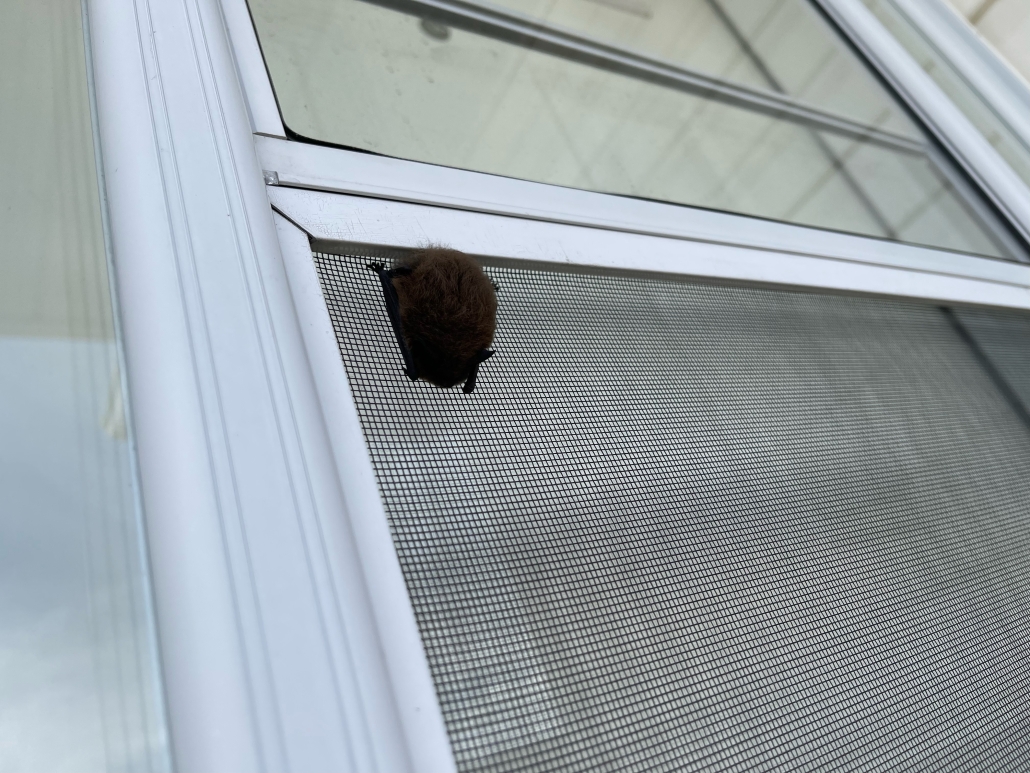
Bats roosting in exposed locations, such as this bat on a screen door, can be left alone and will usually move on at dusk or after a few days. Photo by V.Troyen
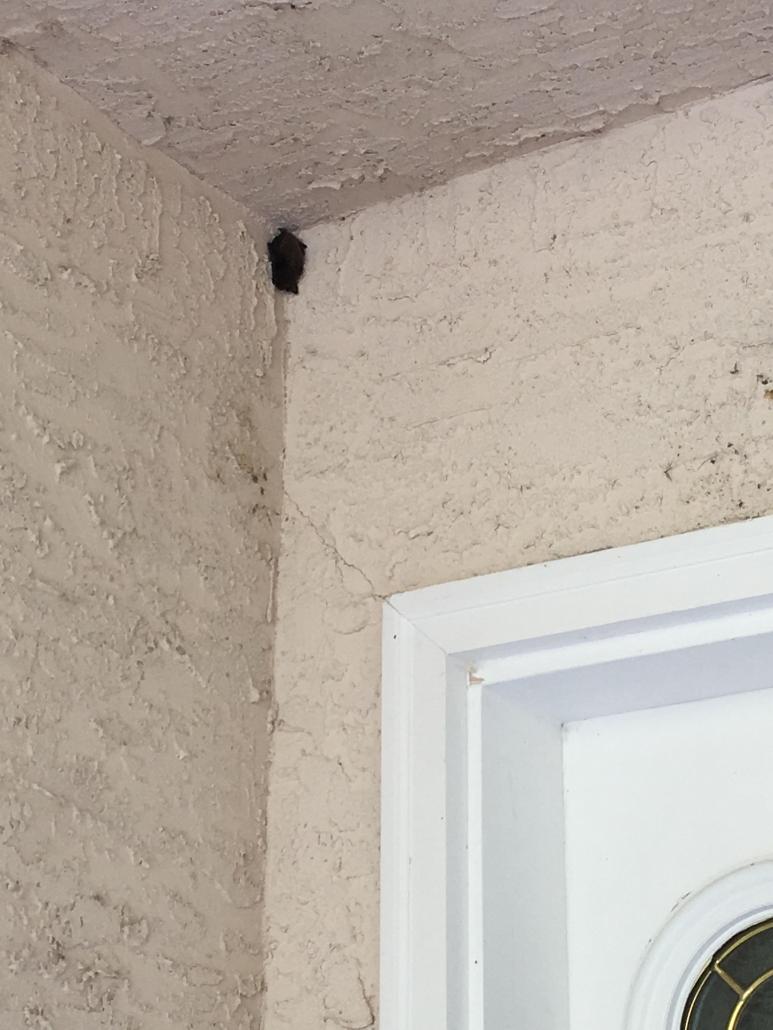
Bat pups are learning to fly and sometimes are found in odd spots like at the top of this entryway. Leave bats alone and they usually will move on at dusk or after a few days. Photo by E. Zachary.

If you find a bat, alive or dead, remember to never touch it with your bare hands. Bats in BC are known to carry rabies at a low level; this is why it is important to avoid any contact. If you must move a bat, use a trowel or similar tool, and always wear leather gloves to protect yourself from direct contact. Talk to your children to make sure they understand to never touch, play or try to rescue injured or sick-looking bats. If you suspect a bite or scratch from a bat, immediately wash the area with soap and water for 15 minutes. Also contact your public health or your doctor as soon as possible, or go to the emergency department.

For more information on rabies please refer to the BCCDC website http://www.bccdc.ca/health-info/diseases-conditions/rabies.

“Bats are important to our ecology and economy. They are the main consumers of night flying insects. Unfortunately, bats are in trouble, and half of the bat species in BC are listed as ‘at risk’,” says Rodriguez de la Vega. Bats are often found in close association with humans, as some species (such as the Little Brown Myotis) have adapted to live in human structures, and colonies may be found under roofs or siding, or in attics, barns, or other buildings. Female bats gather in maternity colonies to have a single pup in early summer, where they will remain until the pups are ready to fly.

“Having bats is viewed as a benefit by many landowners, who appreciate the insect control. Others may prefer to exclude the bats,” says Rodriguez de la Vega. Under the BC Wildlife Act it is illegal to exterminate or directly harm bats, and exclusion should only be done in the fall and winter after it is determined that the bats are no longer in the building. If you have bats on your property, the BC Community Bat Project can offer advice and support.

You can keep bats out of your living space by keeping doors and windows closed and ensuring window screens do not have any holes. If you find a live bat in a room of your home, open the window and close interior doors until the bat leaves, or follow the steps here: https://batworld.org/what-to-do-if-youve-found-a-bat/. “Cat predation is a very common cause of death of bats in BC, which is bad for bat populations and potentially exposes the cats, and their owners, to rabies,” says Rodriguez de la Vega. Keep cats indoors, particularly overnight when the bats are most active, and ensure all cats are vaccinated for rabies.
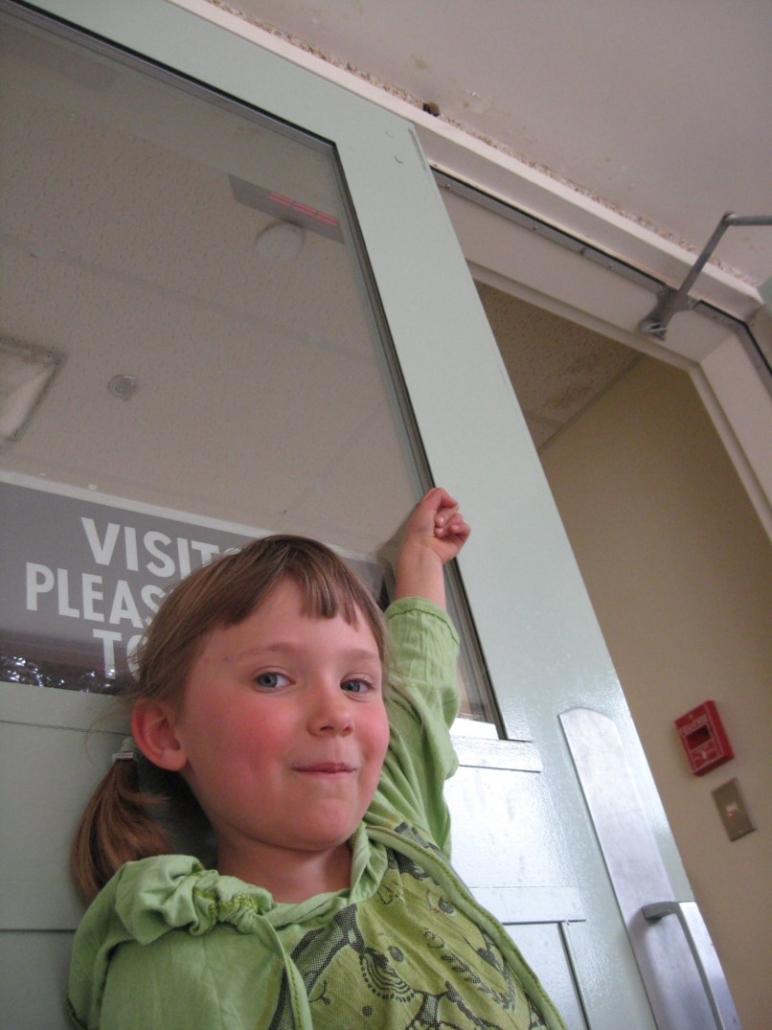
This student is pointing at a bat roosting at the top of the doorway at the entrance of her school. Bats should be left alone unless they are roosting low down where children or pets can come into contact with them. These are great opportunities to teach about bat conservation and safety. Never touch a bat. Leave it alone and it will fly off at dusk or after a few days. Photo by P. Rodriguez de la Vega.

For information on safely moving a bat if necessary and to report bat sightings, landowners can visit the Got Bats? BC Community Bat Program’s website (www.bcbats.ca), email Okanagan@bcbats.ca, or call 1-855-9BC-BATS ext.13. The BC Community Bat Program is supported by the BC Conservation Foundation, the Habitat Conservation Trust Foundation, the Forest Enhancement Society of BC, the Habitat Stewardship Program, the Government of BC. In the Okanagan, we partner with the Allan Brooks Nature Centre in Vernon, the RDCO Environmental Education Centre for the Okanagan in Kelowna, the Bat Education and Ecological Protection Society in Peachland, the Thompson Okanagan Tourism Association, the Osoyoos Desert Centre and many others.

__________________________________________________________________________________________________

Paula Rodriguez de la Vega

Okanagan Region Coordinator, BC Community Bat Program

www.bcbats.ca

Toll free: 1-855-922-BATS (2287) ext.13

Help us detect white-nose syndrome in B.C.  Please report dead bats and unusual bat activity in winter.  Call our toll free line:  1.855.922.2287, ext.13.  For more information see www.bcbats.ca.
Blossoms and Berries — Uses of wild Sunflowers and Saskatoon berries.

Check out Roseanne Van Ee’s recent nature column in the Vernon MorningStar! Learn about different uses of some of our local plants and how to make an Saskatoon Pie!

Spring up to help local bats

BC Community Bat Program’s Okanagan Coordinator asking for help with bats.

With bats waking from hibernation and many returning to the area from long migrations, Paula Rodriguez de la Vega provided ABNC with some great information on helping these little eco champions. Here are some things we can do as we head into spring.

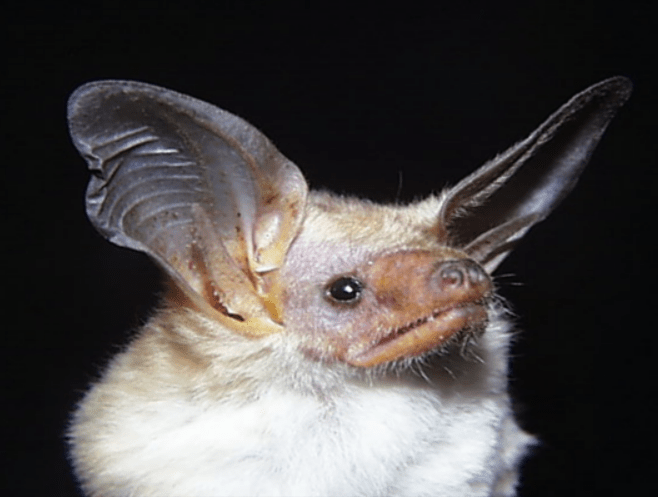
Pallid Bat – Gerson Herrera

Bat boxes and contacts

If you want information about bat boxes, please see our website:  https://www.bcbats.ca/index.php/bat-houses. The Okanagan Community Bat Program sells 4-chamber bat boxes for $150 each, with all proceeds going to bat conservation. 

Alternatively, you can buy them at the Peachland Visitor Centre or at the Vernon Allan Brooks Nature Centre.  Or build your own as per this link:   https://www.bcbats.ca/attachments/Bat_houses_in_BC_2015.pdf

Our program depends on various grants and donations.  If you feel so inclined to support the Okanagan Community Bat Program, please go to:  https://www.bcbats.ca/index.php/get-involved/support-the-bat-program.

Sincerely,

Paula Rodriguez de la Vega

Okanagan Region Coordinator, BC Community Bat Program

www.bcbats.ca

Toll free: 1-855-922-BATS (2287) ext.13

Help us detect white-nose syndrome in B.C.  Please report dead bats and unusual bat activity in winter.  Call our toll free line:  1.855.922.2287, ext.13.  For more information see www.bcbats.ca.
Bat Week at ABNC ends Oct 29th

Media release promotes Bat Week and awareness.

The following is from the BC Community Bat Program in honor of Bat Week–Oct 24 – 29.

ABNC still has the Bat Exhibit until Oct 29. If you haven’t seen it, come up and check it out.

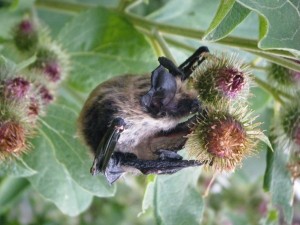
Photo: Long-eared Myotis in Burdock. M-Anion

Trick or … a weed pull? Bat-friendly landscaping can help bats at Halloween

As Halloween approaches, images of scary bats become commonplace. This is the perfect time of year to counter bat myths and do something to help bats, by taking part in International Bat Week (October 24-31).  Bat Week is all about appreciating these amazing animals and their benefits, including eating insects, pollinating flowers, and spreading seeds and nutrients. Maybe try landscaping that helps bats at Halloween.

This BatWeek, consider bat-friendly gardening to help bats! Planting native trees, shrubs, or flowers in your yard, as well as light-coloured and night-blooming flowers, will support the insects that our BC bats like to eat. Controlling invasive plant species also helps insects and bats thrive, so consider a weed-pull in your yard, laneway, or local park or wetland. You can find more information on bat-friendly gardening through the Community Bat Program’s Bat-friendly Communities Guide at www.bcbats.ca or contact info@bcbats.ca

Why BatWeek? “Bats in BC help control agricultural and forest pests, as well as mosquitoes in our yards – but now bats need our help” says Mandy Kellner, Coordinator for the BC Community Bat Program. “Providing safe and healthy habitat for bats has always been important, since over half the species in this province are considered at risk. With the continuing spread of White-nose Syndrome in Washington State, bat conservation is more important than ever as we expect to see impacts in BC in the near future. ” 

BatWeek also marks the time of year when bats disappear from our neighbourhoods, until the return of warmer weather in spring. As insect-eaters, our BC bats must leave their summer roost sites and migrate or hibernate to survive the winter. This absence means that this is the time of year to do home renovations that you have delayed due to bat presence. You can clean out and repair a bat box, or do bat-friendly exclusion work, without disturbing or injuring bats.

If you do see a bat in winter, please report it. Monitoring for white-nose syndrome in BC will continue this winter, with Community Bat Programs requesting reports of dead bats or sightings of winter bat activity.  

In partnership with the BC Ministry of Environment, and funded by the Habitat Conservation Trust Foundation, Forest Enhancement Society of BC, Habitat Stewardship Program, and local funders, the BC Community Bat Program provides information and promotes local stewardship and citizen science. You can report winter bat sightings, find out more about the BC Community Bat Program, BatWeek activities, and options for helping local bat populations, at www.bcbats.ca, info@bcbats.ca, or 1-855-922-2287.

Photos: 

Long-eared Myotis in Burdock – Removing invasive plants such as burdock allows native plants to thrive and reduces hazards for bats. Photo: Marilyn Anions

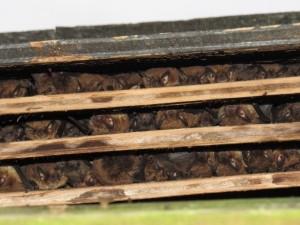
Bats in a bat box: Bat boxes can provide a secure roost site for bats if properly installed and maintained. Photo: Sunshine Coast Wildlife Project

Bats in a box_SCWP

Events

Nothing Found

Sorry, no posts matched your criteria